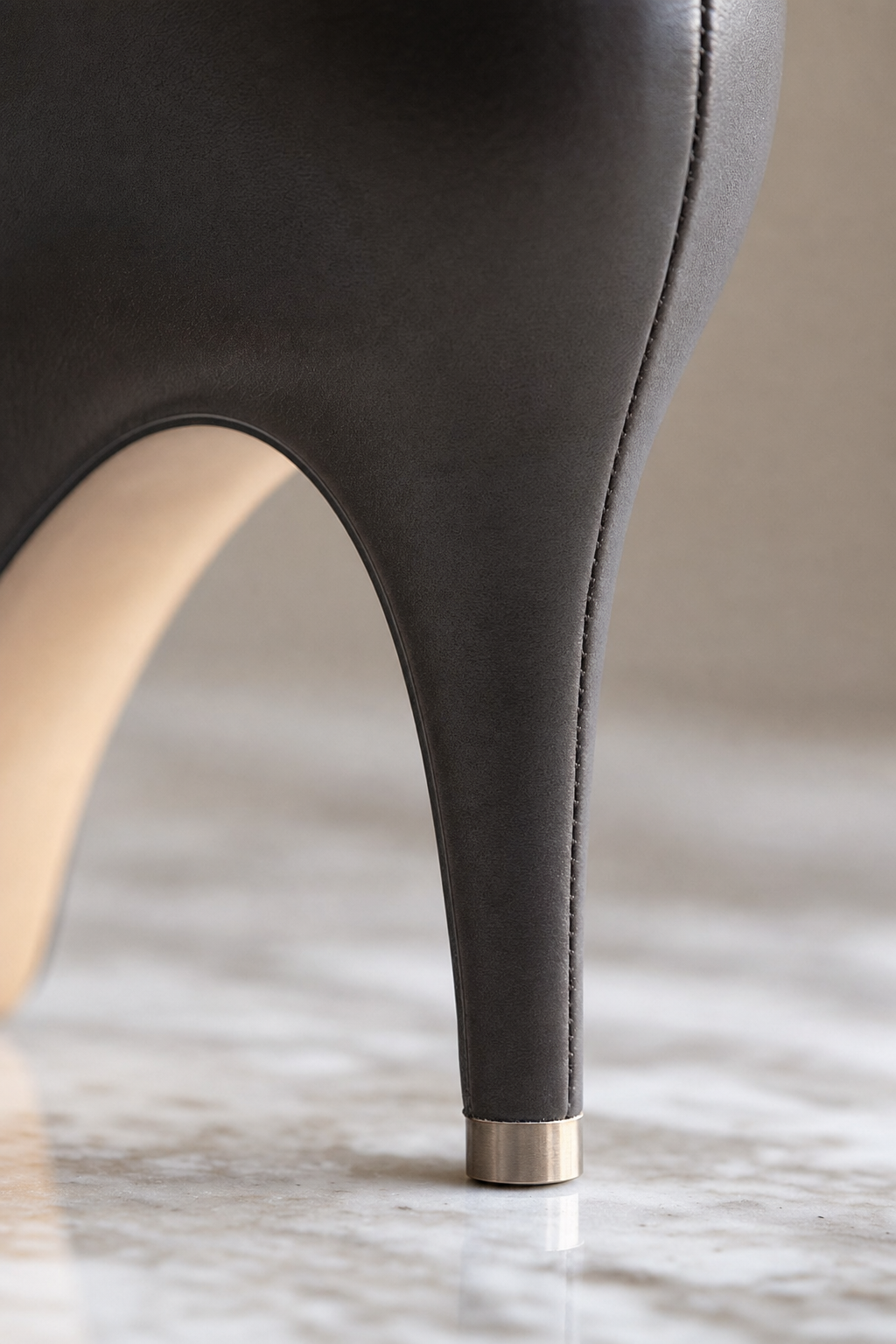
A $300 heel that lasts four years costs more per wear than a $300 heel that lasts twelve. The difference is almost never the purchase price — it is whether the shoe was built to be maintained, and whether anyone maintained it.
This is the routine. It takes about ten minutes a month.
First: Know What You Bought
The care a shoe needs depends on its construction, and Nordic brands split cleanly.
Vegetable-tanned leather with a leather sole — ATP Atelier is the main example. Rewards maintenance more than any other construction: the leather takes on a patina, moulds to your foot, and the sole can be replaced by a cobbler. This is the shoe worth caring for properly.
Full-grain or suede uppers with a bonded rubber sole — Flattered, Roccamore, most of Vagabond. The upper responds well to care; the sole is the limiting factor and is not replaceable. Care extends the useful life within the sole’s lifespan rather than beyond it.
Synthetic or coated uppers — parts of the Vagabond and Anonymous Copenhagen ranges. Wipe clean, don’t condition. Conditioner does nothing to a coated surface and can leave a residue.
If you don’t know which you own, check the sole edge: a leather sole shows a visible layered edge and darkens with wear; a bonded rubber sole is uniform and usually moulded in one piece.
The Routine
After every wear — 30 seconds
Wipe the uppers with a dry cloth to remove dust and salt before it settles into the grain. Insert cedar shoe trees if you have them, or stuff loosely with acid-free tissue — not newspaper, whose ink transfers. This holds the shape while the leather is still warm and pliable, which is the moment shape is either kept or lost.
Then rest them for 24–48 hours. This matters more than anything else in this guide.
Every 10–15 wears — 10 minutes
- Clean. A barely damp cloth for smooth leather. A suede brush, always in one direction, for suede and nubuck.
- Condition smooth leather with a thin coat of a quality cream conditioner. Thin is the operative word — one light application, worked in, then buffed. Skip this entirely on suede.
- Let it absorb for 20 minutes.
- Buff with a soft cloth or horsehair brush.
- Check the heel tips. Worn-through tips are the most common way an otherwise healthy shoe gets ruined, because once the tip is gone you are walking on the heel structure itself.
Twice a season — 20 minutes
Protect. A water-and-stain repellent appropriate to the material, applied to a clean, dry shoe. Reapply after any heavy rain exposure.
Inspect. Look at the heel tips, the sole edge, the seam where upper meets sole, and the lining at the heel counter. Every one of these is cheap to fix early and expensive to fix late.
The Five Things That Actually Destroy Heels
- Wearing the same pair on consecutive days. The moisture your foot puts into the lining needs a full day or more to leave. It doesn’t, the lining breaks down, and the leather stretches out of shape.
- Drying wet shoes with heat. A radiator or hairdryer shrinks and cracks leather fibres permanently. Room temperature, away from direct heat, stuffed with tissue — and be patient.
- Ignoring worn heel tips. A tip costs very little to replace. Walking past that point damages the heel block itself, which usually cannot be repaired economically.
- Over-conditioning. Saturated leather goes soft, loses structure and stretches. If it still feels supple, do nothing.
- Storing them in a plastic box. Leather needs air. Plastic traps moisture, which is how mould starts. A cloth bag or an open shelf.
What’s Worth Buying
You need very little, and the cheap versions of most of it are fine:
- Cedar shoe trees — the highest-value purchase for any leather shoe you intend to keep.
- A horsehair brush — for buffing.
- A neutral cream conditioner — neutral rather than coloured, so it works across your whole rotation.
- A suede brush and eraser, if you own suede.
- A water-repellent spray appropriate to the material.
- Heel tips — or a relationship with a cobbler who keeps them in stock.
That is the whole kit. Anything beyond it is optional.
When to Involve a Cobbler
- Heel tips — as soon as you can see the metal pin or the tip has worn asymmetrically.
- Resoling — for leather-soled shoes, when the sole thins at the ball of the foot. Well before you can see through it.
- Stretching — a good cobbler can gain roughly half a size of width in unlined full-grain leather. Useful if you bought a brand that runs narrow, which the sizing guide covers by brand.
- Relining the heel counter — if the lining has broken down and is rubbing.
Resoleability is one of the reasons ATP Atelier justifies its price over the rest of the Nordic field. If you want the full argument, our comparison with Flattered works through the cost-per-wear case in detail.