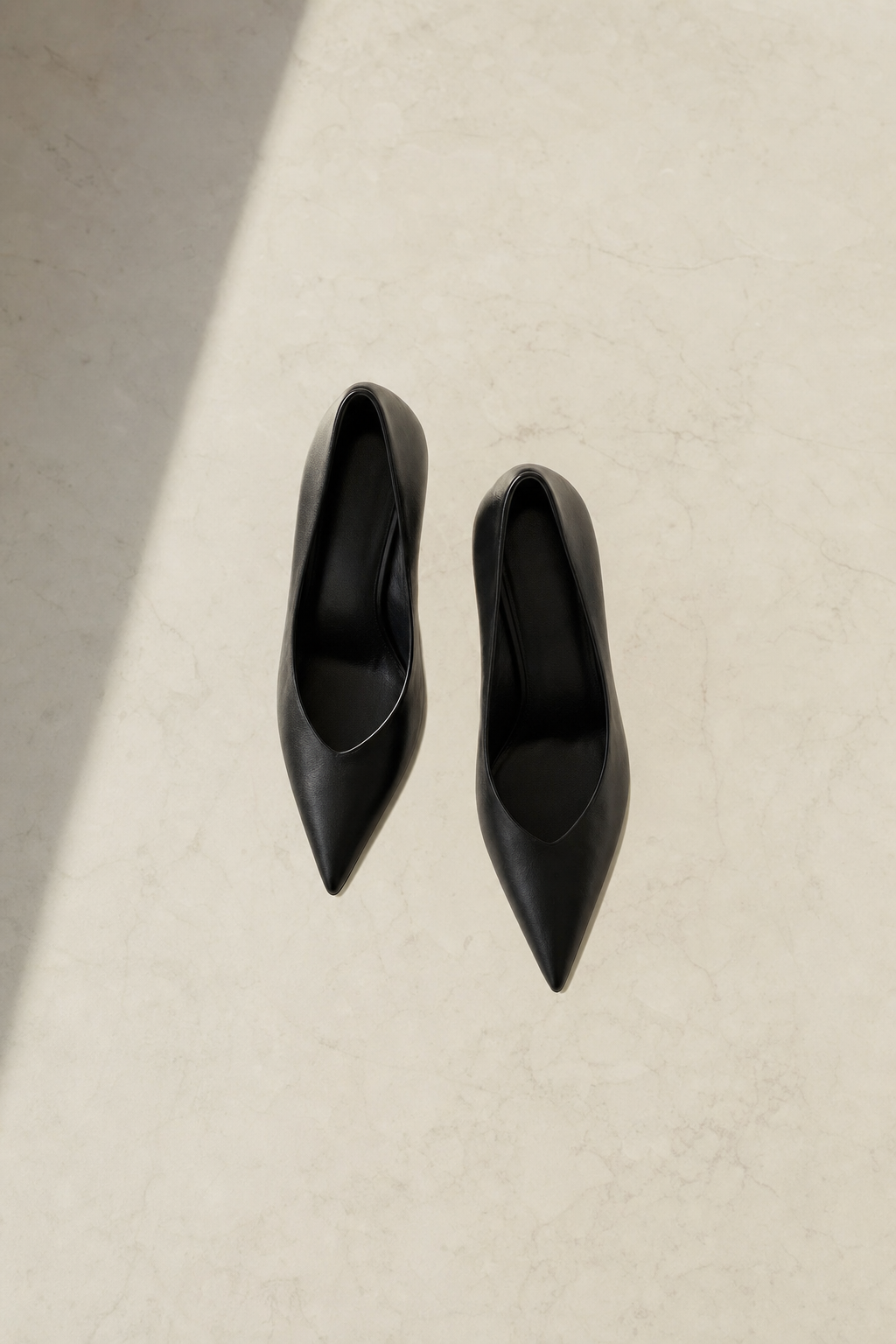
“Comfortable heel” is the most abused phrase in footwear marketing. Almost every brand claims it; very few build for it. The ones that do tend to be Scandinavian, and they tend to be explicit about the engineering rather than vague about the cushioning.
This edit covers what actually produces comfort in a heeled shoe, and which brands deliver it.
How we assess comfort. We work from construction specifications, each brand’s published design rationale, heel geometry, and the recurring themes in publicly available customer reviews. We do not run wear tests and don’t pretend to — where we describe how a shoe performs over a long day, that is drawn from documented design intent and the consistent pattern of what wearers report. See our affiliate disclosure for how this site is funded.
The Four Things That Actually Matter
Before the brands, the criteria — because once you can see these, you can assess any heel yourself, including ones we’ve never covered.
1. Pitch. The angle your foot sits at, set by heel height minus any platform. This is the single biggest factor and the one marketing never mentions. A 90 mm heel on a 20 mm platform has the pitch of a 70 mm heel, and your forefoot knows the difference.
2. Base width. How much area carries your weight, and how much stability your ankle has to supply. This is why a block heel is easier than a stiletto at identical height — and why heel shape matters more than heel height below about 70 mm.
3. The footbed. Whether there is genuine support under the arch, or just a flat insole with padding glued on. Padding compresses within weeks. Structure doesn’t.
4. The toe box. Whether your toes are held or compressed. A pointed toe narrows precisely where the foot is widest. No footbed rescues a toe box that is too tight.
The Edit
1. Roccamore — the most engineered option
Copenhagen, roughly $200–$350.
Roccamore was founded specifically to solve this problem, and its insole was developed with a Copenhagen orthopaedic shoemaker to hold the foot as close to anatomically correct as a heel allows. Of everything in this edit, it is the brand whose comfort claim is most clearly structural rather than cosmetic — and it looks like a clean Danish heel, not an orthopaedic one.
Who it’s for. Standing work, long events, anyone who stopped wearing heels for physical rather than aesthetic reasons.
What to know. The engineering does its best work in the mid-heights. Standard width — it’s a fatigue solution, not a width solution.
2. Flattered — the best balance of the four factors
Stockholm, roughly $180–$350.
Flattered started from the question of why heels are uncomfortable and concluded the answer was lazy construction. The result gets three of the four factors right: a supportive footbed, a rounder toe box than its competitors, and a stacked block heel in the 50–70 mm range where the pitch stays reasonable.
Who it’s for. The best default if you want one comfortable heel that doesn’t look like a compromise.
What to know. Narrow last — go up half a size for wider feet, and prefer the round-toe styles. The direct comparison with Roccamore is here.
3. ATP Atelier — comfortable eventually, and then for years
Skåne, roughly $250–$450.
An honest entry with a caveat. ATP Atelier is not comfortable out of the box — the vegetable-tanned leather is stiff and needs two to three weeks to soften. What it then does, uniquely in this edit, is mould to your specific foot and stay that way, because the leather keeps taking your shape rather than compressing flat.
Who it’s for. People buying for a decade rather than for Saturday.
What to know. Budget the breaking-in period honestly. If you need comfort on day one, buy Flattered instead — the full comparison is here.
4. Vagabond — the low-risk way to test the theory
Sweden, roughly $100–$200.
No anatomical claims, but Vagabond gets the geometry right on its block-heel styles: broad bases, sensible heights, square-ish toe boxes, and wide fits on part of the range. At this price it is the cheapest way to find out whether a 60 mm block heel works for you before spending three times as much.
Comparison
| Brand | Structured footbed | Typical height | Toe box | Comfort on day one |
|---|---|---|---|---|
| Roccamore | Yes — orthopaedic insole | 50–80 mm | Round | Excellent |
| Flattered | Yes — anatomical | 50–70 mm | Round, narrow last | Excellent |
| ATP Atelier | No — moulds over time | 40–70 mm | Generous | Poor, then excellent |
| Vagabond | No — good geometry | 50–70 mm | Square, wide fits | Good |
| Aeyde | No | 60–90 mm | Square | Moderate |
| Anonymous Copenhagen | No | 70–100 mm | Narrow | Moderate |
Buying for All-Day Wear
If the shoe genuinely has to survive a full day on your feet:
- Stay at or below 70 mm unless there’s a platform doing real work.
- Choose a block or column heel, not a stiletto — the ankle-stability saving is larger than people expect.
- Prioritise toe box over everything if your feet are wide. Start with the wide-fit edit.
- Buy late in the day, when your feet are at their largest.
- Add gel forefoot pads, not full insoles. A heel has no spare volume for a full insole.
Our heel height guide works through matching height to occasion in more detail, and the sizing guide covers the EU conversions that cause most returns in this category.